
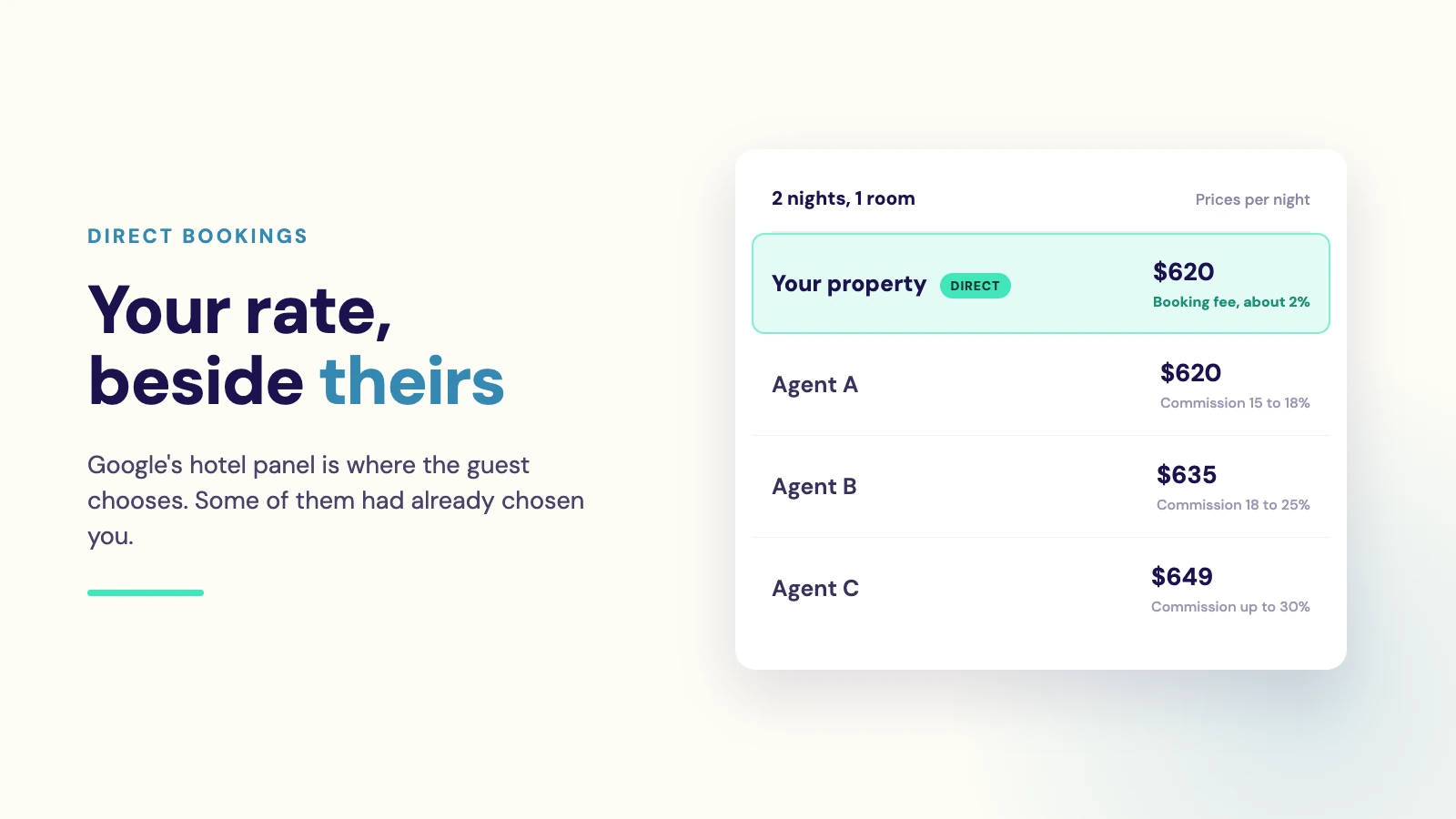
Some of the guests who book your rooms chose you before they went looking for a rate. They researched you, or your brand and reputation had already done the work. Then Google returns a panel of rates from Booking.com, Expedia and Agoda beside yours, the booking goes to whichever one is easiest to click, and you pay commission on a guest you had already won.
What is that panel?
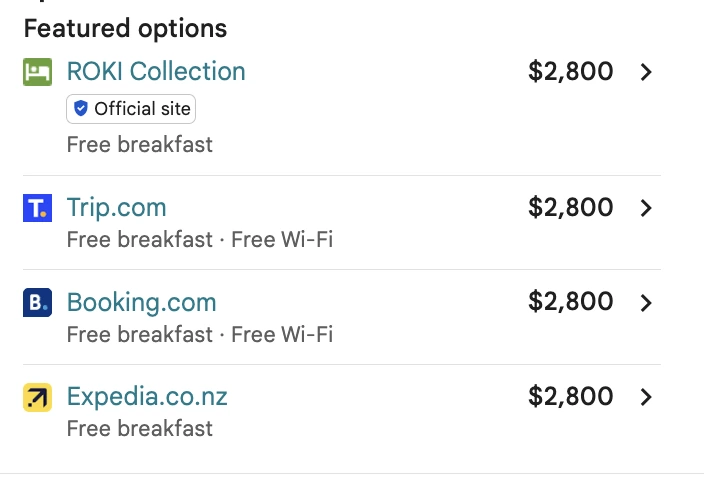
It is the list of bookable rates Google shows when someone searches your property by name. Your own rate can sit in it, priced live from your booking system through Google Hotel Ads, so the guest books with you without leaving Google. When your rate is missing, the only options shown are the OTAs and other booking sites who pay to be there.
Who paid to create that demand?
You did. The campaigns, the content, the reviews and the years of guest experience are what make someone search your name instead of a destination. The OTAs and other booking sites arrive at the last step, after the client's choosing is done.
That is what makes the commission expensive. It typically runs 15 to 30%, charged on demand you created and paid for once already. A booking through your own engine costs a few percent in commission payment and booking engine fees, and that difference is the margin on every booking you move.
Who owns the guest after the booking?
A direct booking leaves you holding the guest information: their email address, who they travelled with, what they spent on beyond the room, and permission to speak to them again.
A booking through an OTA or different booking site leaves most of that information with them, meaning you can't contact them for future outreach. Every booking you take directly adds a guest you can sell to again at no commission. That is the part of the gain that keeps paying after the first stay.
How do you test it without betting the plan?
Connect the free booking link first. That is your own rate and booking link shown in the panel with nothing charged to Google for the click, so once the rate feed is connected there is no bid to set and no result to wait on.
Run the Google Hotel Ads paid placement as a contained test beside the channels already running e.g. Booking.com, Expedia, and any other OTA channels you are using. We would usually keep the other channels live through the test window, along with the paid campaigns you already run, so the comparison stays clean.
Nothing rests on the outcome. If the channel does not earn its place you stop it, and the bookings you have today keep arriving as they did before.
Define the read before you switch anything on. Measure bookings, impressions and clicks through the new channel against the channels you already run, and watch whether OTA volume holds, so you can tell demand you captured from demand you moved.
Give it a full booking cycle. Accommodation lead times are long enough that a single month tells you almost nothing about whether the channel captured new demand or took bookings that were coming anyway.
Why do most of these tests prove nothing?
The result has nowhere to show up. In most accommodation reporting, bookings from the panel land inside a single direct total that also holds brand search, returning guests and email.
Split that total by channel before the test starts and the answer becomes readable: what the channel booked, what it cost you, and whether it took volume from anywhere else. It is the same reason we build journey based reporting for every client we work with.
How we approach it
We work on direct booking growth for luxury accommodation operators, and the shape of the opportunity repeats: the demand already exists, and the gain comes from capturing more of it at a lower cost than an OTA or booking site charges for the same booking.
Metasearch reaches that guest at the moment of choosing, on a surface your website cannot reach on its own. We treat it the way we treat any new channel: connect what is free to connect, test the paid placement beside what already works, read it against a benchmark set in advance, and scale only the part that earns it.
Want to know what your direct channel is worth?
We map where your bookings come from, what each channel costs you, and which of them has room to grow.
See how we do it
Written by
Sophie Schollum
Digital Marketing Specialist
Sophie is a digital marketing specialist at Data Story. She writes about paid media and direct booking strategy for accommodation providers.
LinkedInRelated articles

SEO & GEO
How destinations can improve performance using category search SEO
28 September 2026
Category search happens when a traveller knows the kind of trip they want but has not chosen where to take it. We show which pages reach these undecided searchers and how to build them.
Read article
Destination and Experience
Your destination does not have an awareness problem
23 September 2026
How to tell whether awareness is your problem, and what to fix before you fund another campaign.
Read article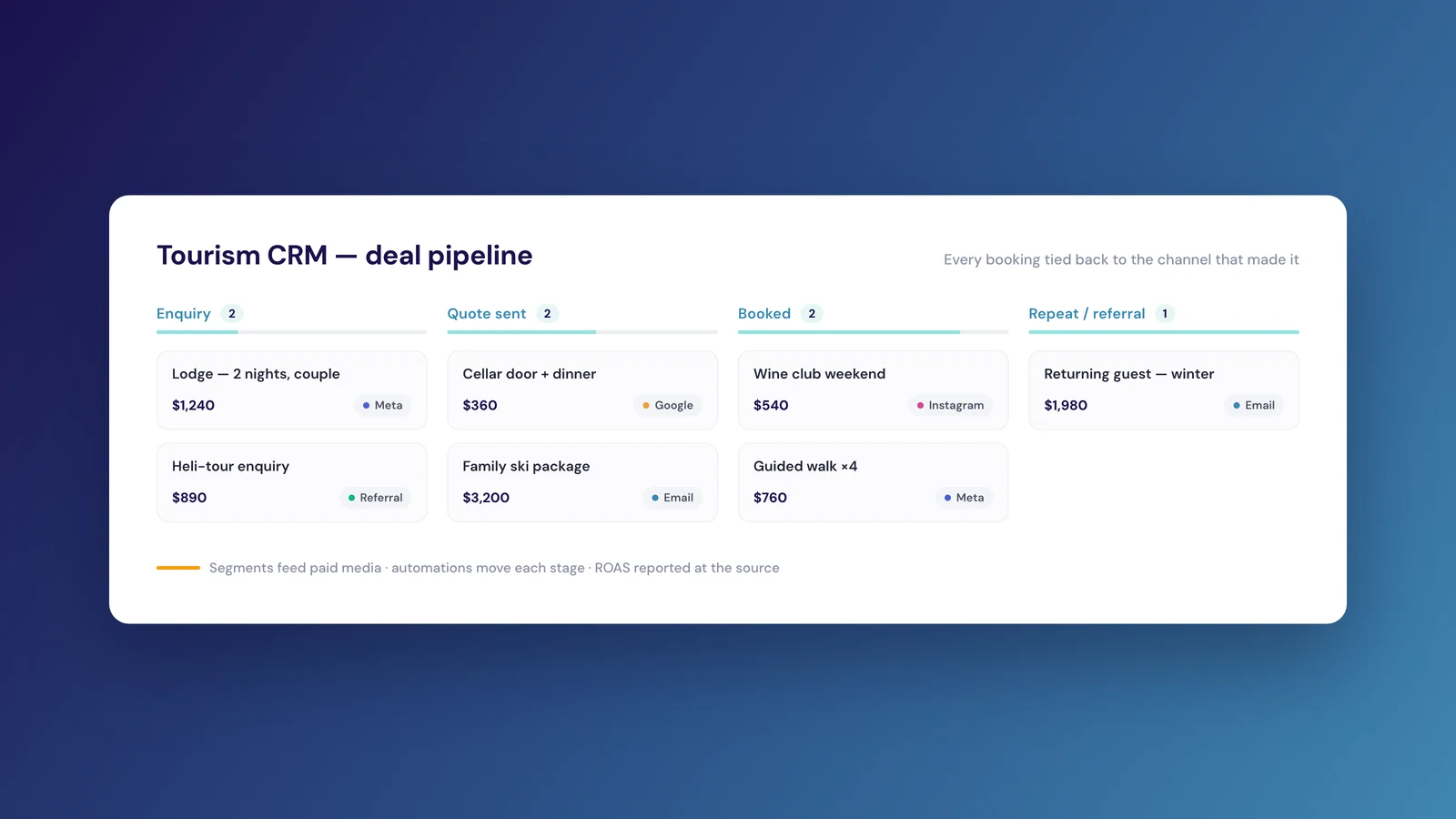
CRM
How we do CRM for destinations, experiences and tourism businesses
22 July 2026
For a tourism business, the difference between a CRM that holds contacts and one that drives revenue sits in a few specific places: attribution, audiences, automation and repeat bookings. How we refine each.
Read article