
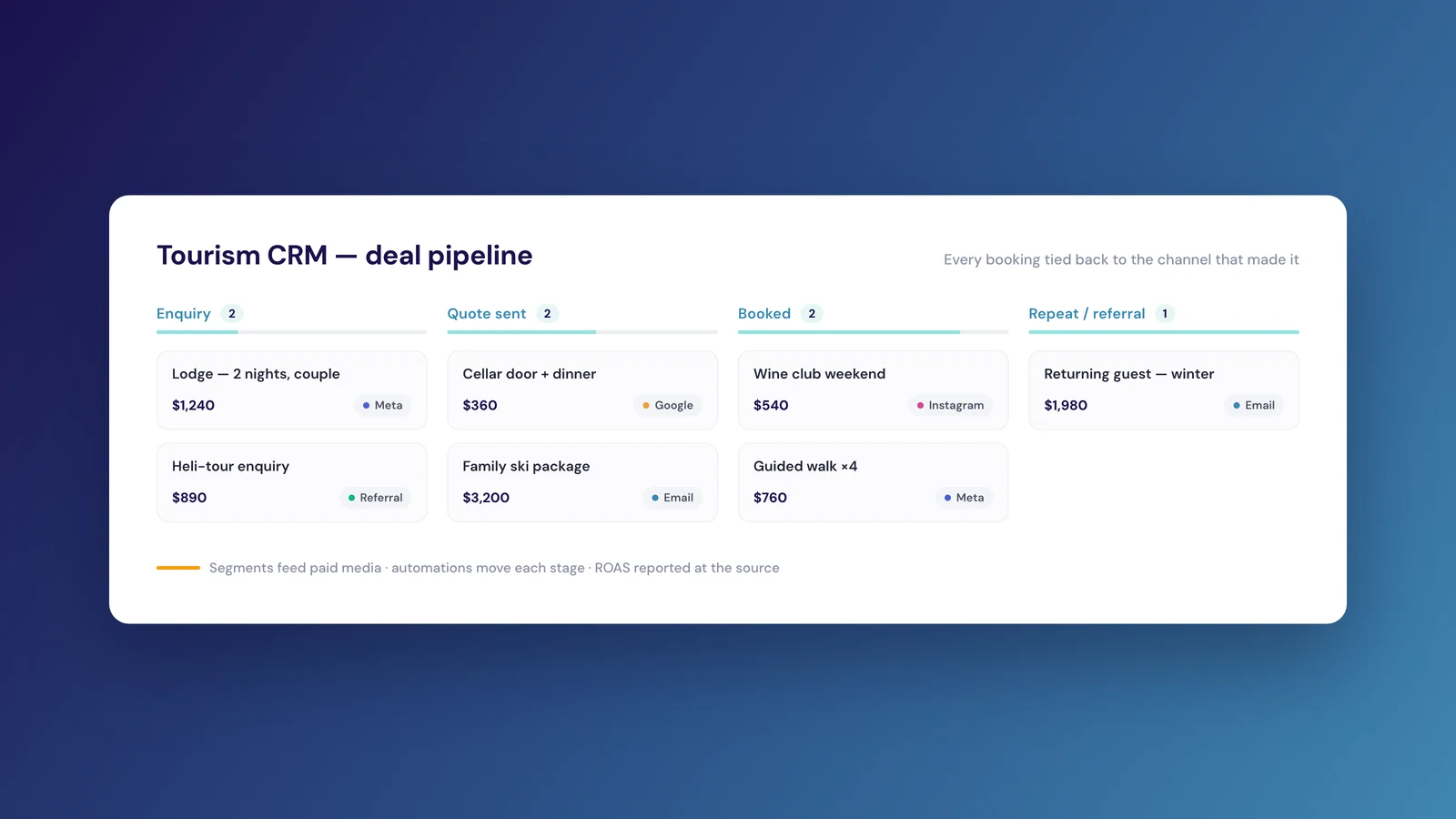
For a tourism business, the difference between a CRM that holds contacts and one that drives revenue sits in a few specific places: connecting a booking to the campaign behind it, feeding sharper audiences to your paid media, carrying a guest from enquiry to a repeat visit, and segmenting finely enough to be worth acting on.
These are refinements more than rebuilds, and they compound. When we reworked MountainWatch Travel's HubSpot, traffic from their email marketing rose 200% and replies rose 104%, from the same audience with no added spend.
The platform was already in place. The gains came from the detail: cleaner data, tighter automations, and reporting that made the funnel visible again.
Start with how a customer reaches you
We start by mapping every point where a customer reaches you: forms, live chat, WhatsApp, Instagram, a booking widget, a referral from an operator. Each is a place the CRM can carry more of the work.
The map shows where an automation earns its place, and where a person should still handle it. That becomes the order of work, highest return first.
A destination and an operator use it differently
A tour operator or a lodge uses a CRM the obvious way. Capture the enquiry, move the deal through a pipeline, close the booking, then bring the guest back. The pipeline stages mirror how the sale already runs, and automation moves a deal forward when a customer acts.
A destination marketing organisation works differently, because it rarely sells the booking itself. The value there is content relevance, tracking referrals out to operators, and knowing the audience well enough to segment it. A CRM earns its place for a destination by measuring those referrals and feeding what it learns back into the marketing.
Automation that moves a customer for you
Lifecycle stages earn their value when the triggers are automatic. We define the rules that move a contact forward, so a form submission or a booking advances them to the next stage and the database becomes a funnel you can report on.
Deal pipelines follow the business. An online experience starts the pipeline at purchase, a bespoke lodge or event starts it at enquiry, and some bookings worth a lot stay manual on purpose, because a template would slow them down.
Tie the booking back to the marketing that made it
When a website changes often, conversion tracking in analytics breaks and the numbers stop being trustworthy. Setting the conversion event inside the CRM counts a booking once, at the source, whatever the site does that week.
With booking, quote and proposal data in the CRM, we tie a closed deal back to the ad channel that started it. That is what makes return on ad spend (ROAS) reporting real, and restoring that funnel visibility across MountainWatch Travel's branches was a large part of their rebuild.
Feed your paid media from the CRM
The segments you hold in a CRM are the audiences your ad accounts want. Lists of past guests, enquirers and members feed straight into Meta and Google, where they seed lookalike audiences and exclude the people who have already booked, so the spend reaches sharper targets.
Paid media works the other way too, as a controlled test of who to target. For Tairāwhiti Gisborne we ran four audience archetypes against tailored landing pages, and the behavioural signals showed which visitors carried real intent. That lifted intent to plan and book a Gisborne trip 16% and engaged traffic 72%, and it told the destination which audiences to build the rest of its marketing around.
Growing the customer you already have
A tourism business rarely sells one thing. A lodge has a restaurant, a cellar door, experiences and retail; a destination carries dozens of operators. The guest who books once is a candidate for the next, and a CRM is where that second booking gets planned and prompted.
Whether that repeat is cheaper than a new booking depends on the business, and a CRM is how you tell. Where it does pay, the return sits in the second booking, the extra service, and the visit that repeats a season later. A review request, a referral incentive, a membership that gives a reason to return: each reaches someone who already trusts the brand, and each is cheap to run once the automation holds it.
The same thinking runs through journey mapping for retention. Map where a customer goes after the first booking, then back the moves that carry them to the next service or the next stay. For a business with several revenue lines and a database in the thousands, that is where the largest growth usually sits.
All of it depends on knowing who is who. Segmentation that separates a new enquiry from a returning guest, or a club member from a day visitor, lets each message reach the right person instead of the whole list.
Start with an audit
An audit gives you a clear read on where the returns are, ranked by what each one is worth. That ranking is the hardest part to see from the inside, and it is what keeps the work pointed at revenue rather than tidiness.
The MountainWatch results came from that sequence: an existing HubSpot, audited, cleaned up, and pointed at the parts that drive bookings.
Getting everything you could from your CRM?
The largest gains are usually in the platform you already run, pointed at the work that grows revenue.
That is what I do at Data Story: CRM audits, the automations that turn a booking into a review and a repeat visit, and the reporting that ties bookings back to the marketing that made them. A short audit shows what your CRM could do next, ranked by what it returns.
Rather talk it through first? Book a call. Want to keep up as the ground shifts? Get our newsletter.

Written by
Sabrina Poulin
CRM & Automation Specialist
Sabrina is Data Story's HubSpot expert, building CRM systems and marketing automation workflows that save teams time and improve conversion. She has designed lifecycle journeys for luxury accommodation operators, RTOs, and B2B businesses across the region.
LinkedInRelated articles

SEO & GEO
How destinations can improve performance using category search SEO
28 September 2026
Category search happens when a traveller knows the kind of trip they want but has not chosen where to take it. We show which pages reach these undecided searchers and how to build them.
Read article
Destination and Experience
Your destination does not have an awareness problem
23 September 2026
How to tell whether awareness is your problem, and what to fix before you fund another campaign.
Read article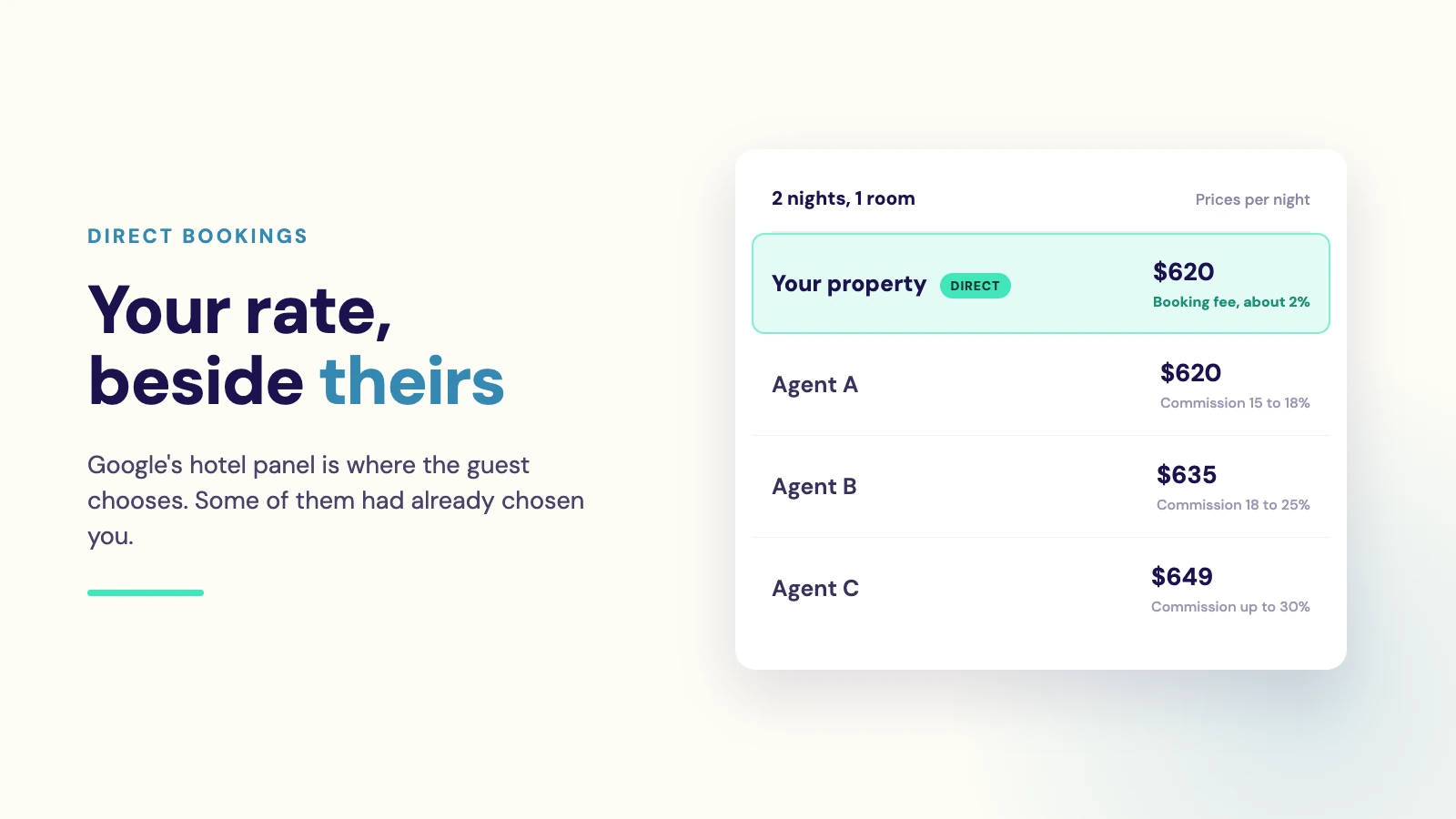
Paid Media
Why pay commission on guests you already won?
13 August 2026
Your brand, your reputation and your marketing earn the guest. Then the booking goes to an OTA, and the commission and the guest relationship go with it. How to use Google Hotel Ads to hold on to the booking, the relationship and the data.
Read article