

Google Chrome cookie changes in 2024
Google Chrome is the number one browser worldwide, far ahead of its competitors. It holds almost 66% of the market share; its closest competitor, Safari, sits at just 13% (source: gs.statcounter.com).
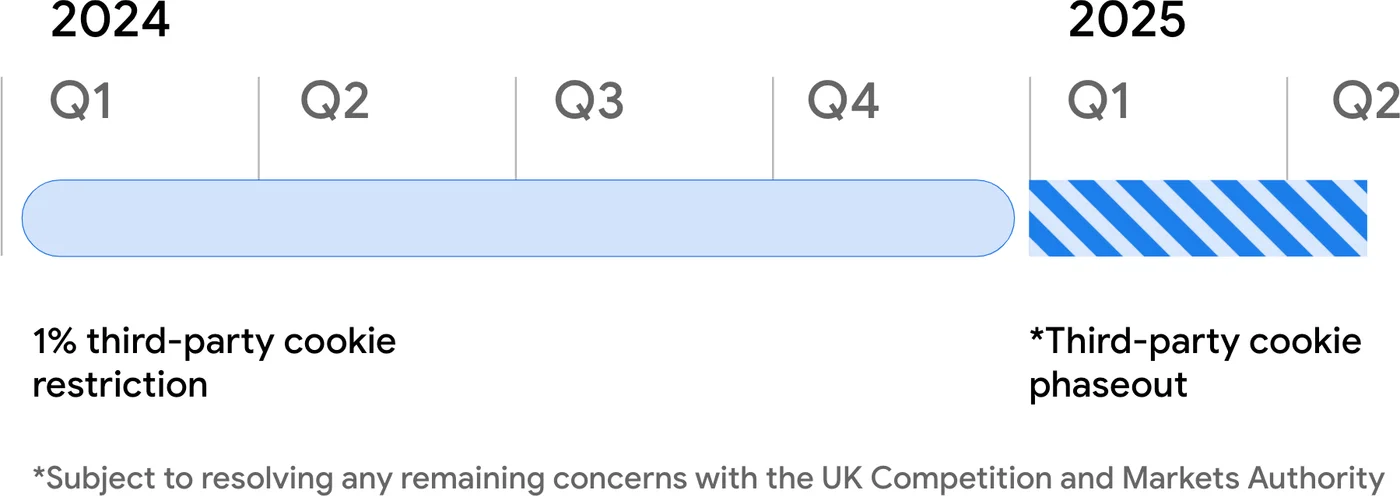
On 4 January 2024, Google announced a third-party cookie restriction for 1% of users during the first quarter of the year. They plan to phase out third-party cookies in early 2025.
So, what should we do about these upcoming changes? Well first, let's start with the basics.
What is a third-party cookie and why does it get negative attention?
Third-party cookies are set by domains other than the one a user is visiting. They are often used for tracking user behaviour across different websites for purposes like targeted advertising and analytics.
Cookies, and especially third-party ones, have received negative attention from regulators, primarily due to the potential risks associated with their usage:
- Privacy concerns: cookies can be used to track users' online activities — browsing history, preferences, behaviour. This tracking can infringe upon user privacy, especially if users are not aware of or do not consent to the collection of their data.
- Data security risks: if used by the wrong person, cookie data can be exploited to recover personal information. This can expose users, especially when sensitive data is involved.
- Transparency and control: because many users are unaware of what a cookie is or how it works, they often don't understand the extent to which their data is being tracked. They are also often the victims of poor communication about the collection and use of their data, with limited control over the process.
For all these reasons, Google is working to eliminate the use of third-party cookies across Chrome.
What impact will the changes have on my website?
The third-party cookie measures may only concern Google Chrome for the moment. However, Chrome's dominant position means the changes will have a large impact on site owners and advertisers. It is also highly likely that other browsers will gradually follow Google's example.
Here are the potential impacts:
- Tracking and ad targeting. Third-party cookies are widely used to track users across different websites, enabling advertisers to target ads based on users' browsing behaviour. Without these cookies, ad targeting could have accuracy issues.
- Measuring advertising effectiveness. Third-party cookies are also used to measure the effectiveness of online campaigns by tracking users' journey from ad display to conversion. Removing them adds complexity and reduces reliability.
- Increased reliance on proprietary data. Advertisers will rely more on their proprietary data — users registered on their websites, or first-party data from partnerships with other companies.
- Innovation in alternative targeting solutions. Expect innovation in alternative ad targeting technologies, such as contextual targeting (based on page content rather than user behaviour) and anonymous identifiers based on technologies like federated encryption.
- Impact on advertising revenues. Some publishers may see an initial drop in advertising revenues and ROI, particularly if advertisers reduce online spend due to uncertainty surrounding new targeting methods.
What has Google introduced as part of these changes?
As part of its attempt to evolve managing user consent, Google has created Google Consent Mode V2. This tool enables websites to communicate a user's cookie consent status to Google tools such as Google Ads and Google Analytics. In other words, it respects user privacy whilst allowing data collection for advertising and analytics.
Using a cookie banner or widget, consent mode dynamically tracks and adapts how user data and ad personalisation are passed to tracking platforms and third-party tags. It became mandatory in March 2024 and requires the installation of a Consent Management Platform (CMP) or a cookie consent banner integrated with Google Tag Manager. Your website is responsible for obtaining and managing user consent and ensuring compliance with regulations.
How do I prepare my business for the end of third-party cookies?
It is crucial to conduct a comprehensive analysis of the cookies utilised on your website to identify and understand the role of third-party cookies in your tracking and advertising ecosystem.
1. Audit your cookies
Begin by auditing your website's cookies to differentiate between first-party and third-party cookies. Understand their functions: tracking user behaviour, retargeting, or serving personalised ads.
2. Evaluate impact
Assess the potential impact of losing third-party cookies on your tracking, targeting, and advertising strategies. Consider factors like audience segmentation, ad performance measurement, and user experience.
3. Explore alternatives
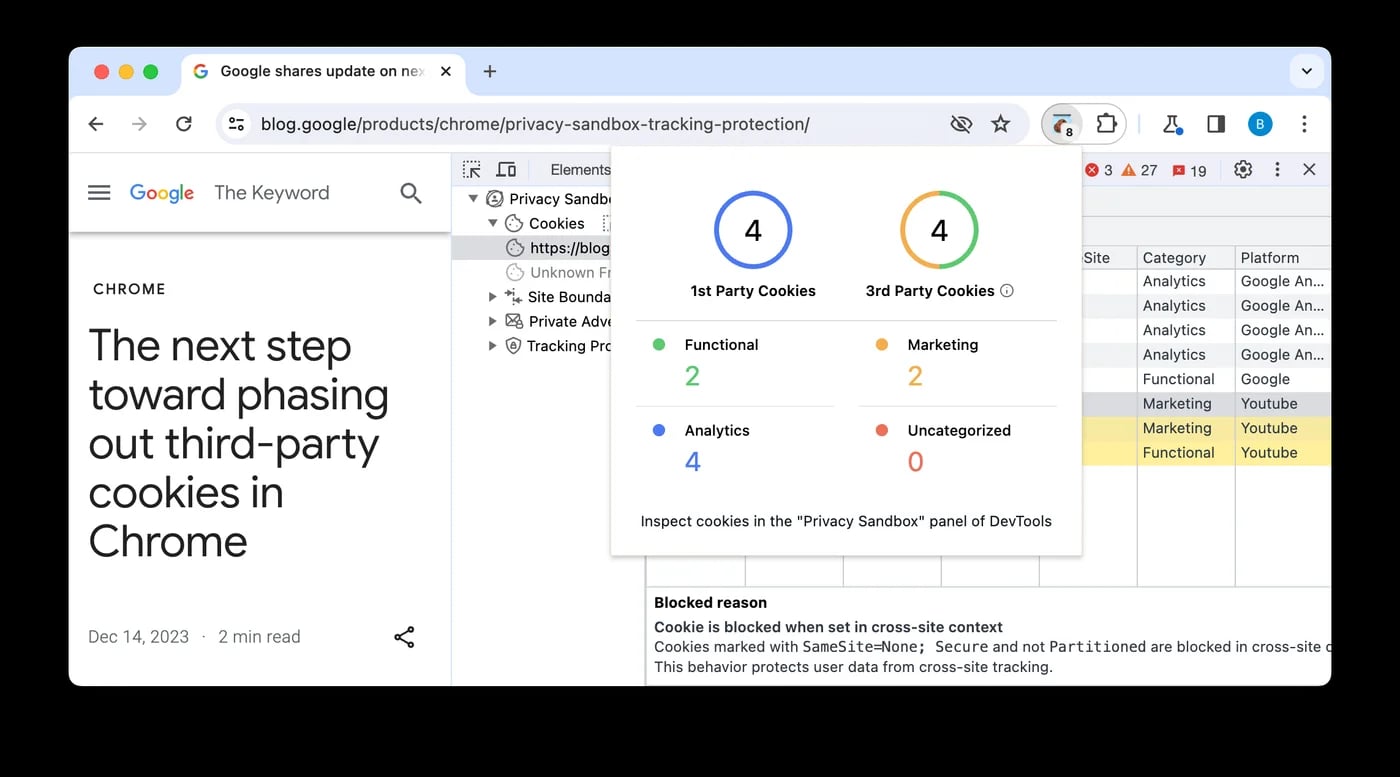
Research and experiment with alternative tracking and targeting methods. This could include first-party data collection, contextual advertising, or cohort-based targeting solutions. Leverage tools like Google's Privacy Sandbox Analysis Tool (PSAT) to simulate scenarios and understand the implications of various alternatives.
4. Test and iterate
Continuously test different tracking methods and advertising strategies to optimise performance and adapt to evolving user preferences and regulatory requirements. Monitor key metrics and refine your approach based on real-world data and feedback.
Do you need help?
As a specialist in growth marketing, Data Story can help you identify the impact of the changes to third-party cookies on your website. We can provide a response tailored to your specific context and needs.
Whether it's exploring tracking and targeting alternatives, implementing privacy-preserving solutions, or adjusting your advertising campaigns, we're here to guide you every step of the way. Get in touch.
ℹ️ Info
This article does not constitute legal advice in terms of your use of cookies. We recommend that you obtain legal advice if you are not sure of your legal obligations.

Written by
Arthur Davey
Performance and Insights Lead
Arthur heads up performance and analytics at Data Story. He specialises in GA4 implementation, custom dashboards, and extracting the insights that drive measurable marketing improvements. Arthur is the team's resident data detective — he finds the signal in the noise.
LinkedIn