
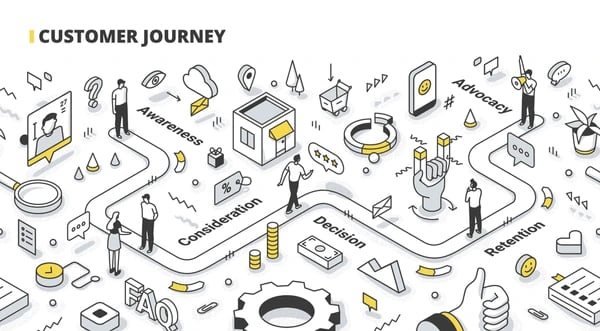
In today's competitive business landscape, understanding your customer journey is paramount to achieving marketing success. Gone are the days of one-size-fits-all marketing approaches; now, personalised experiences are essential to capturing and retaining customers.
The customer journey refers to the entire path a customer takes, from the initial awareness of your offer to the final purchase and beyond. By measuring and optimising this journey, your business can gain valuable insights into your customers' needs, preferences, pain points, and motivations. This knowledge enables you to deliver personalised experiences, build strong relationships, and ultimately drive customer satisfaction and loyalty.
What is your customer journey?
A customer journey is the path of interactions an individual takes to become a customer. It describes both direct interactions, such as purchasing online, and indirect interactions, such as hearing about your brand from a friend.
We call it a journey because purchasing something is a decision that happens over time. This is based on human psychology established since the beginning of mankind. Before marketing was defined, people would trade with people they knew, liked, and trusted to ensure their safety and well-being. This is the same today — people must know you exist, trust you are reliable to transact with, and believe the value is greater than the cost and effort to get the result you help them achieve. Otherwise no sales and no business.
Therefore your marketing must expose your brand to people, build trust, and convince them to buy from you. Note how similar this is to what every business must do. If you were to do an MBA, you would learn that every business must do four things:
- Attract a market
- Close a sale
- Deliver a product or service (value)
- Measure it and make profit
If we don't measure the right things we can't improve the right things. So your data needs to cover these four areas of your business when measuring performance.
Why "story"?
My clothes turned to ice. I took them off and looked for a fresh pair — before realising that I hadn't actually brought one. The pair I just removed took off with the wind and over the mountainside. I was now standing — bare — on an arctic summit. I had no way of avoiding full-body frostbite and death by hypothermia. It was 3 AM and there wasn't a soul within miles. That was the day I lost everything. And this is the story of what happened next.
Chances are, you want to keep reading that story. A hook is created in your mind. What happens next?
Stories play a vital role in how we understand the world. They provide meaning, organise information, evoke emotions, foster empathy, and shape our identities. By using stories, we create a framework to interpret our experiences, make sense of complex concepts, and connect with others on a deeper level.
Re-read that paragraph. Seeing your customer story is like entering The Matrix. It allows you to see the code running the world. Then you can bend that code and enter your brand into your customer's story.
Donald Miller, in Building a StoryBrand, lays out the seven parts of a story in his SB7 framework. Your customer — the hero — has a problem that needs to be solved. They meet a guide — your business — that helps them overcome their problem and is transformed.
Consider how this fits into what every business must do and the only four ways to grow a business:
| Customer story | Buying journey | Leverage | Quant metric | Qual metric |
|---|---|---|---|---|
| Customer becomes aware of how you help them | Attract | Get more customers | CAC | Conversion rate |
| They choose whether you can help them | Convert | Get customers to spend more | AOV | Customer satisfaction |
| They're transformed using your help | Deliver | Improve experience and lower cost to serve | Revenue or referral rate | Margin |
| They become advocates and keep being guided by you | Advocate | Get customers to buy again and refer | Repeat purchase rate | Employee satisfaction |
Typically a customer journey follows these steps:
- Awareness
- Consideration
- Engagement
- Conversion
- Experience
- Post-experience / repeat or cross-sell
Or consider a common tourism customer journey:
- Dreaming of a holiday
- Planning a holiday
- Booking a holiday
- The experience
- Sharing and booking again
In lifecycle marketing, where someone is only in market at certain points in their life — having a baby, for example — the journey often looks like:
- Market entry (pregnant)
- Passive looking (you know you need a pram, but aren't actively searching)
- Active looking (shopping, reviews, how-to videos)
- Lead gen and education (sign up for educational material about parenting)
- Evaluate your offer (look at your product page)
- Purchase
- Experience (welcome email nurture, delivery, unboxing and setup, using)
- Repeat and share (reviewing, talking with other parents, buying add-ons like a bassinet or cup holder)
As marketers, we craft journeys for customers. The goal is to move people along the journey to becoming and staying customers. And where we can, making ways for those customers to help us get more customers.
This is why the customer journey is critical to measuring marketing performance. By breaking down the journey into key moments, you can focus. Focus allows you to determine what success should be. And when you can define success, you can measure it. And if you can measure it, you can improve it.
Why you need focus in marketing
"A person who chases two rabbits catches neither." — Confucius
I remember running print ads a long time ago. I would send a draft ad for approval, and it would come back with requests like, "can we also add a special promotion, and add a picture of our other product too. And our address." Next thing you know, that ad is so complicated no one wants to look at it. It's too much effort to process. We call this cognitive load in behavioural psychology.
Focus allows you to create great, personal moments. These moments connect with people. Connection is memorable and persuasive. The marketing speaks to you.
For example, you have a goal to create awareness to in-market audiences. Success looks like reaching a good amount of people at a good cost, who take an action to show they are engaged. This can lead to sales, but sales is not the goal. Awareness is. This focus allows you to focus on creating a moment that will introduce people to who you are. Because you're clear on this moment — who it's for, that they don't yet know and trust you — you can craft something entertaining or helpful. This is the start of building trust.
Some people call this brand, but we call it the first step in your customer journey. Or just good marketing.
This is a simple concept, but many marketers fail to break down their marketing by the steps in their customer journey. They simply want to put out ads and have people sign up and buy in one hit. The real world does not work like this — especially not for expensive experiences.
That's where Data Story comes in.
Your customer story puts customers first
The greatest businesses are customer focused. That means they put delivering value to their customers as their primary focus. Amazon, Apple — they have all innovated to deliver value to customers.
So you should too. Here's why. Delivering a huge amount of value allows you to:
- Charge more and make more margin
- Get more repeat purchases
- Get people sharing, referring, and talking about your business
- Sell in other products and services
- Get massive results, achieve your work goals, make more money, and live the dream
Customer focus is why the greatest businesses are great.
Customer journey is your data story
Nobody cares about data. People want insights that help achieve goals. Your customer's data story is the key to insights. Good analysts talk about finding a narrative in the data.
Make analysis easier and faster by collecting and categorising your data to the customer journey. Narratives and clear insights become so much easier. Don't trust me — try it.

Written by
Dave Hockly
Director
Dave founded Data Story with a belief that better data leads to better marketing. With over a decade in digital marketing across tourism, hospitality, and growth businesses, he specialises in turning complex analytics into clear business strategy. Dave leads client relationships and oversees the agency's strategic direction.
LinkedInRelated articles
Customer Journey
You can't do good marketing with AI until your data is organised for it
16 July 2026
Read article
Destination and Experience
The tourism journey is too long to measure by gut
16 July 2026
Read article
Customer Journey
Why customer journey mapping for retention matters as much as acquisition
8 July 2026
Most annual plans are a stack of channel targets. The strongest ones start with how a customer moves through the business, then build the targets around it.
Read article